Developing real-time location intelligence for Prague Airport

Engineering a location intelligence platform that turns WiFi signals into operational clarity.

Client
České radiokomunikace (CRA)
Services
RTLS platform architecture, Signal processing algorithms, Microservices development, Kubernetes & DevOps, Production operations
Industries
Transportation, Airport Operations, Real-time Location Services (RTLS), IoT

Overview

Vaclav Havel Airport Prague needed precision visibility into terminal operations. Where passengers and staff move, how crowded specific areas become, and how long queues form at key points – this intelligence is valuable for operational efficiency, safety, and passenger experience.

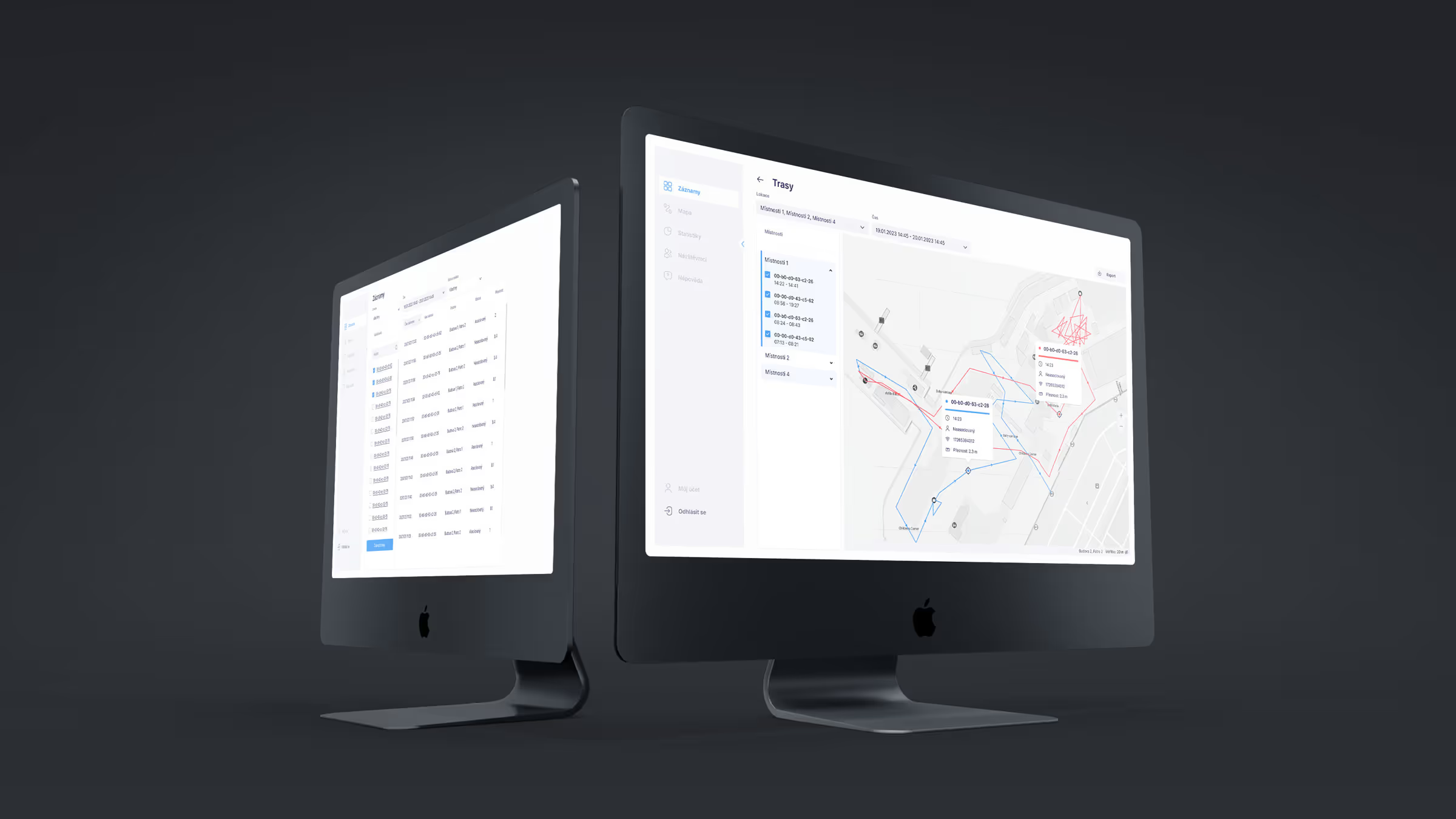
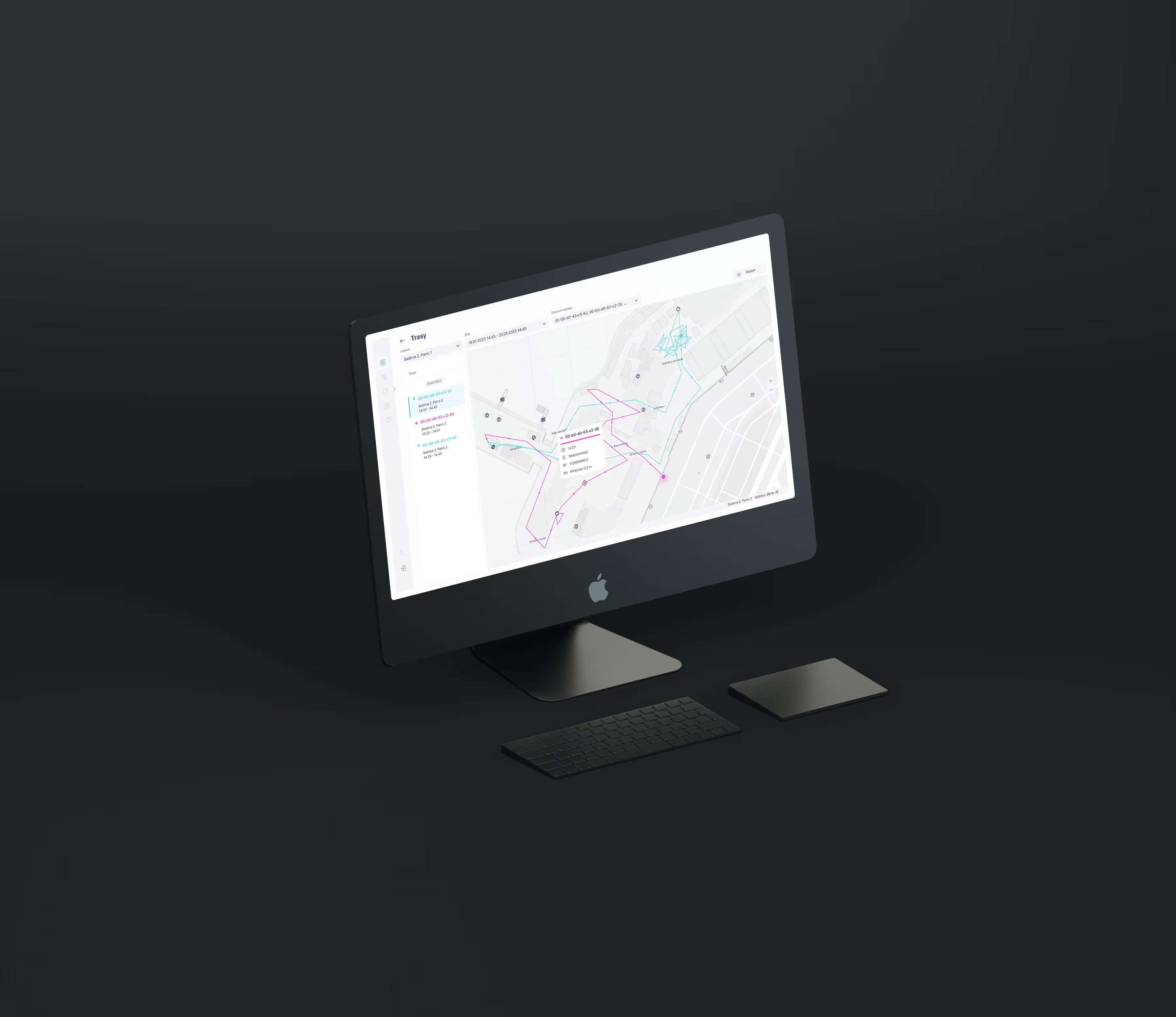
CRA engaged WDF to build a proprietary indoor positioning platform. The result is a production-grade, high-availability system that ingests wireless signals from thousands of access points, calculates real-time device positions via trilateration, and serves operator dashboards with live location data. The platform processes millions of signal samples per hour, maintains sub-second latency, and has run without interruption at the airport since May 2023.

Rather than a one-time delivery, WDF and CRA have maintained an active engineering partnership. WDF continues to operate the system, monitor its health, respond to incidents, and implement new features – making CRA the owner of a mature, maintainable technology rather than a consumer of a black-box service.

The Business 
Challenge

Indoor WiFi-based positioning is technically and operationally harder than it first appears.

A constant flood of wireless signals arrives from the airport's thousands of devices and access points. Every signal carries information about the sender's location, but only if the system can parse it, group it with related signals, and apply sophisticated algorithms to triangulate position – all in near-real-time. Scale matters: an error or delay at any layer compounds into missing or stale data for operators.

Beyond raw processing, the airport demanded reliability. A positioning system is operational infrastructure: failures impact decision-making and safety. The platform had to include redundancy, failover logic, automated recovery, and 24/7 observability. Operators also needed simple, intuitive dashboards – not an engineering tool.

Finally, CRA wanted to own the technology. Third-party RTLS vendors lock customers into proprietary formats, restrict customization, and shift costs upward over time. WDF's challenge was to deliver a system that CRA could eventually operate independently, while remaining available for evolution and support.

Our Role

WDF took end-to-end responsibility: designing the architecture, implementing each component, deploying to production, operating the system, and evolving it based on real-world demands.

The team designed a microservices architecture optimized for stream processing. Wireless signals flow into an RTLS receiver that parses the raw protocol, forwards data to Kafka (distributed message broker), which distributes work to a data processor that groups signals by time window and device MAC address, then to a position calculator that performs trilateration. Results are stored in PostgreSQL and served via REST API to the frontend operator dashboard.

Each layer was built for independent scaling, debugging, and replacement. Redis caches frequent lookups. PostgreSQL partitions data by time, keeping recent data hot and archiving older data to NFS storage. Kubernetes orchestrates the entire stack, managing failures and distributing load.

The frontend is a React application with Leaflet maps – giving operators an intuitive view of real-time positions overlaid on airport layouts.
The Delivery Journey

From wireless signal ingestion to production RTLS, WDF balanced algorithmic rigor with operational simplicity – ensuring the airport gained a reliable, maintainable positioning system.

Phase 1

Establishing Real-Time Foundations

The initial phase prioritized architectural correctness over speed to market. WDF invested in business analysis and technology selection, recognizing that the wrong foundation would become expensive to change later.

The team designed a Kafka-based streaming pipeline, choosing distributed messaging to decouple signal ingestion from processing – critical when handling millions of events per hour. PostgreSQL was selected for its partitioning capabilities, enabling efficient storage of large time-series data. Kubernetes provided orchestration, allowing the team to scale compute resources independently as data volume grew.

During this phase, WDF also built the trilateration algorithm—the intellectual core of the system. WiFi signal strength is noisy; the algorithm had to filter outliers, weight signals by proximity, and handle coverage gaps gracefully.

Phase 2

Pilot Refinement & Algorithm Optimization

Pilot testing revealed that real-world conditions differed from assumptions. Certain areas of the terminal had unexpected WiFi patterns; signal reflections and obstructions created dead zones. WDF iteratively refined the calculation algorithm, added adaptive weighting, and improved failover behavior.

The team also stress-tested the system under realistic load, identified latency bottlenecks, and optimized the data processing pipeline. This phase ensured that when the system went live, it would be stable from day one.

Phase 3

Production Operations & Continuous Evolution

Since May 2023, the platform has run continuously at the airport, handling every flight day's traffic without major incidents. WDF's role shifted to operations: monitoring system health, responding to incidents, and implementing enhancements.

A notification service was added in 2024, allowing operators to set alerts on crowding, congestion, or security thresholds. API refinements enable integrations with other airport systems. Performance optimizations keep latency low as data volumes grow.

This phase demonstrates long-term partnership: WDF is not a vendor that builds and leaves, but an engineering team that keeps the system healthy and evolving.

Why It Matters

CRA now operates with proprietary positioning technology that is faster and more customizable than off-the-shelf RTLS vendors. The airport has:

  • Real-time operational intelligence: Precise, live visibility into passenger and staff movement, enabling responsive facility management.
  • Ownership & control: The technology belongs to CRA. They can modify algorithms, integrate with other systems, and plan roadmaps without vendor constraints.
  • Reliability at scale: A 24/7 system handling millions of events per hour, running on production-grade infrastructure with redundancy and automated backups.
  • Engineering partnership, not vendor dependency: WDF continues to support, monitor, and evolve the platform, but CRA owns the system.

For prospective clients, CRA demonstrates WDF's capability to architect and operate complex, distributed systems: handling high-volume real-time data, solving algorithmic problems, deploying to Kubernetes at scale, and maintaining production infrastructure with precision.

Technologies

Python

Used for complex data ingestion pipelines, emissions modeling algorithms, and valuation logic.

React

Building the data-rich dashboards and visualization tools used by analysts and decision-makers.

AWS

The secure, scalable foundation hosting the entire platform, from compute to managed databases.

PostgreSQL

Reliable primary storage for user data, fleets, and core application state.

TypeScript

Powering the core microservices architecture and API layer for high-performance data delivery.

Talk to
our team

Share how we can reach you, and we’ll arrange a brief call with both a product and engineering expert from WDF to walk through your situation and answer questions.

By clicking “Send message”, you allow WDF to store and process your personal data to handle your request in accordance with our Privacy Policy. You can withdraw your consent at any time.

Thank you! Your submission has been received!
Oops! Something went wrong while submitting the form.

Prefer to reach out directly?

Vojta Strnad
Vojta Strnad
Director at WDF